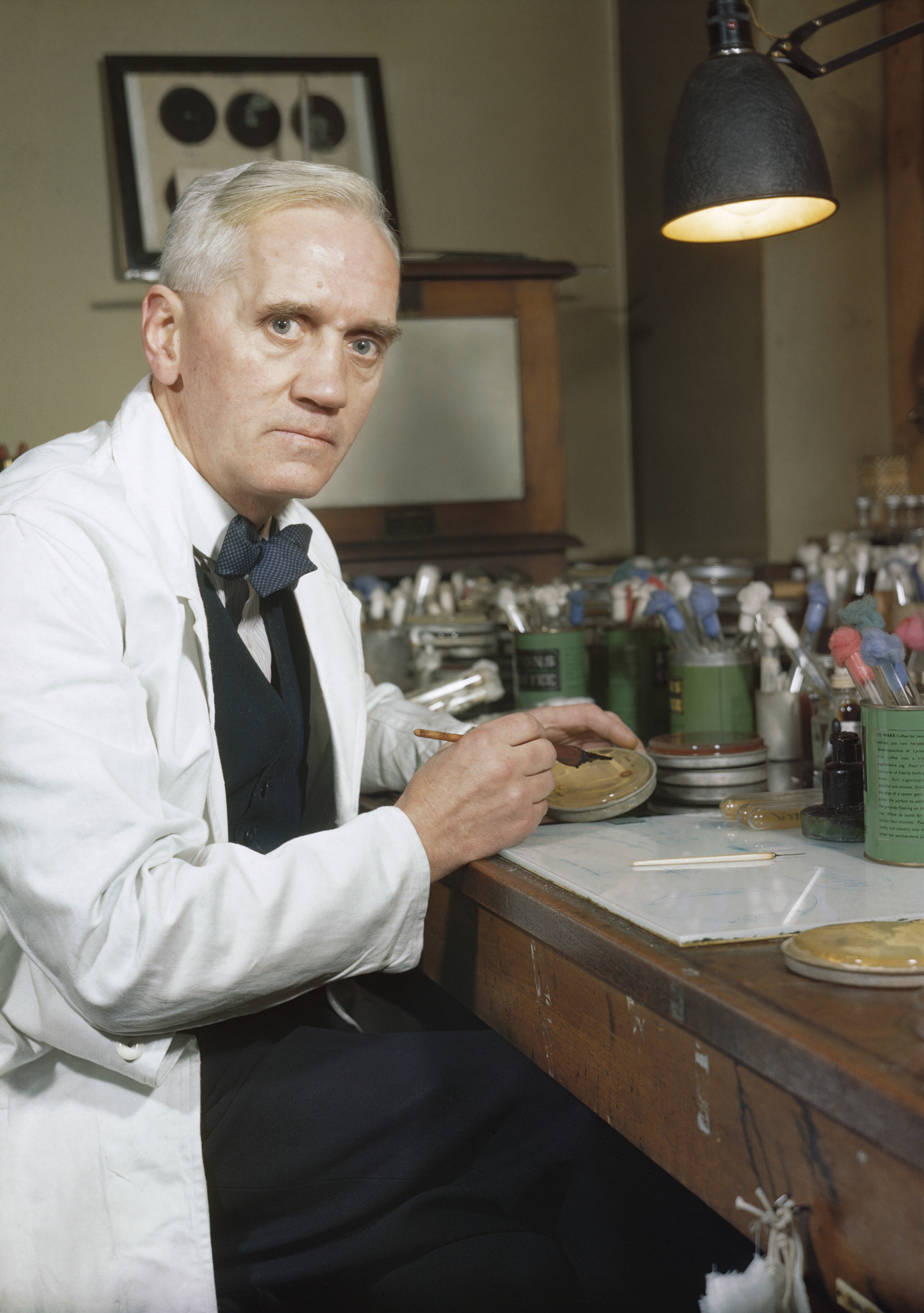
Alexander Fleming
bacteriologist
Profile Needs Work (48% ready)
This profile is published but still missing: Bio sections, Timeline, Quick facts.
Alexander Fleming Scottish bacteriologist who discovered penicillin in 1928 when he observed that mold from the Penicillium genus was killing the bacteria in his petri dish. This accidental discovery led to the development of antibiotics, which have since saved hundreds of millions of lives. He shared the 1945 Nobel Prize in Physiology or Medicine.
Overview
Sir Alexander Fleming was a Scottish physician and microbiologist. He shared the 1945 Nobel Prize in Physiology or Medicine with Howard Florey and Ernst Chain "for the discovery of penicillin and its curative effect in various infectious diseases". This was the first antibiotic substance discovered. His discovery in 1928 of what was later named benzylpenicillin from the mould Penicillium rubens has been described as the "single greatest victory ever achieved over disease".
Wikipedia Context
This profile section is complemented from Wikipedia for Alexander Fleming. Scottish physician and microbiologist (1881–1955)
Sources
Primary source page: https://en.wikipedia.org/wiki/Alexander_Fleming
Timeline
Birth
Birth of Alexander Fleming.
personalWikipedia Complement
Profile metadata and editorial blocks were complemented using Wikipedia and Wikidata references.
careerProfile Update
Structured profile components were updated to improve completeness.
careerQuotes
"Profile note: Alexander Fleming was complemented using Wikipedia reference material."
"Editorial note: This block stores profile notes and source context, not attributed quotations."
"Source note: https://en.wikipedia.org/wiki/Alexander_Fleming"
Partner picks | Control
Related to Alexander Fleming
Books and titles you might enjoy.
Community
Reader Comments
A more blog-style discussion space for reactions, context, and corrections.
Loading comments...